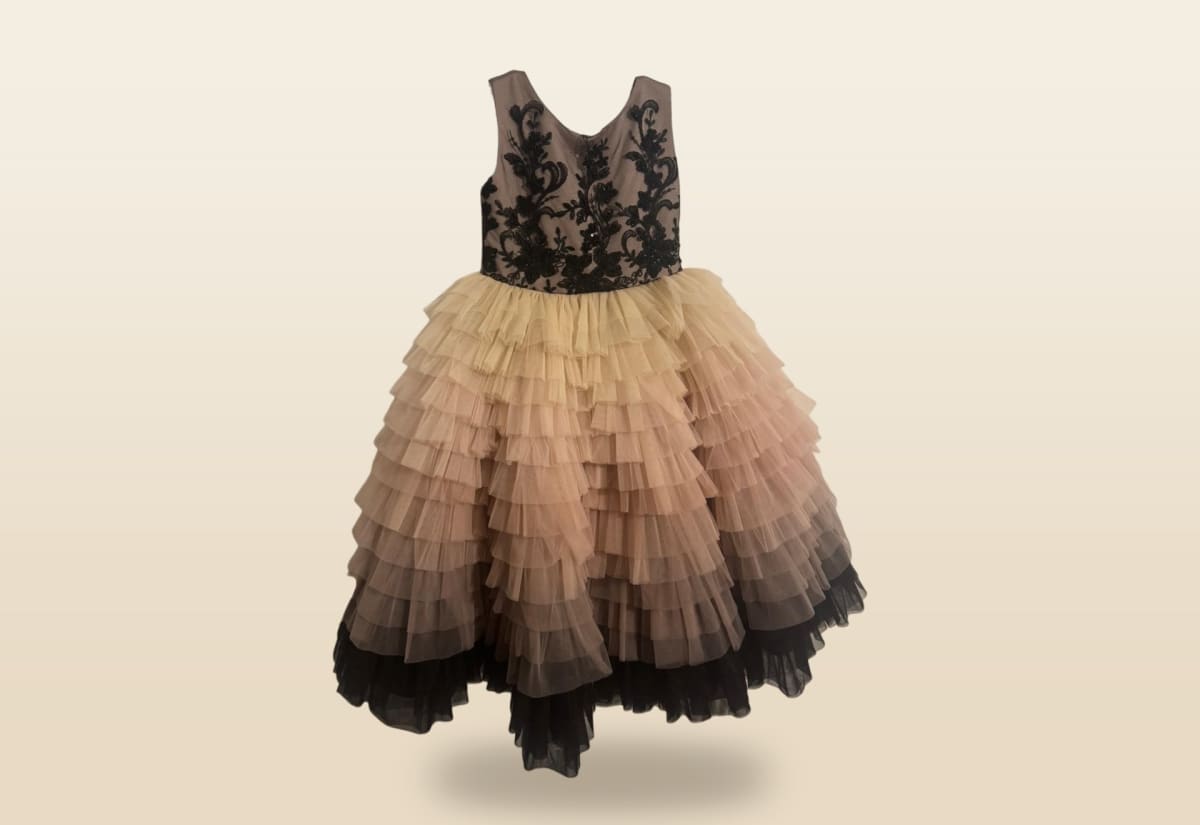
From a distance, an ombré gown looks like a single, impossible gesture — colour melting into colour as though it had always been that way. Up close, it is the opposite of effortless. It is patience, made visible.
A colour is never one colour
The grade you see on the Aurora — lilac surfacing into sky — is not printed, and it is not dyed in a single bath. It is built in layers. Panels of tulle are cut, graded, and assembled so the eye reads a seamless transition where there are, in fact, dozens of deliberate steps. Get one layer wrong and the whole gradient announces itself.
The hands it passes through
A single gown can pass through a dozen pairs of hands before it reaches the orchard:
- the colourist, who decides where one shade should yield to the next
- the cutter, who must waste almost nothing and align almost everything
- the machinist, who joins layers so fine they tear if you look at them unkindly
- the finisher, who hand-tacks the hem so it falls rather than hangs
- and the person who, at the very end, simply checks that it is beautiful
Why we choose them
We could stock dresses made faster. Everyone could. We choose pieces like the Aurora — with its colourblocked panels and crystal belt — precisely because you can feel the hours in them. There is a quality of made-with-time that no shortcut reproduces, and children, strangely, are its most honest audience. They twirl harder in a dress that was built to be twirled in.
What you are really buying
When you buy a gown that took this long to make, you are buying the hours as much as the cloth. You are buying someone's decision to do it properly when faster was available.
That decision is the whole house, in a single dress.